
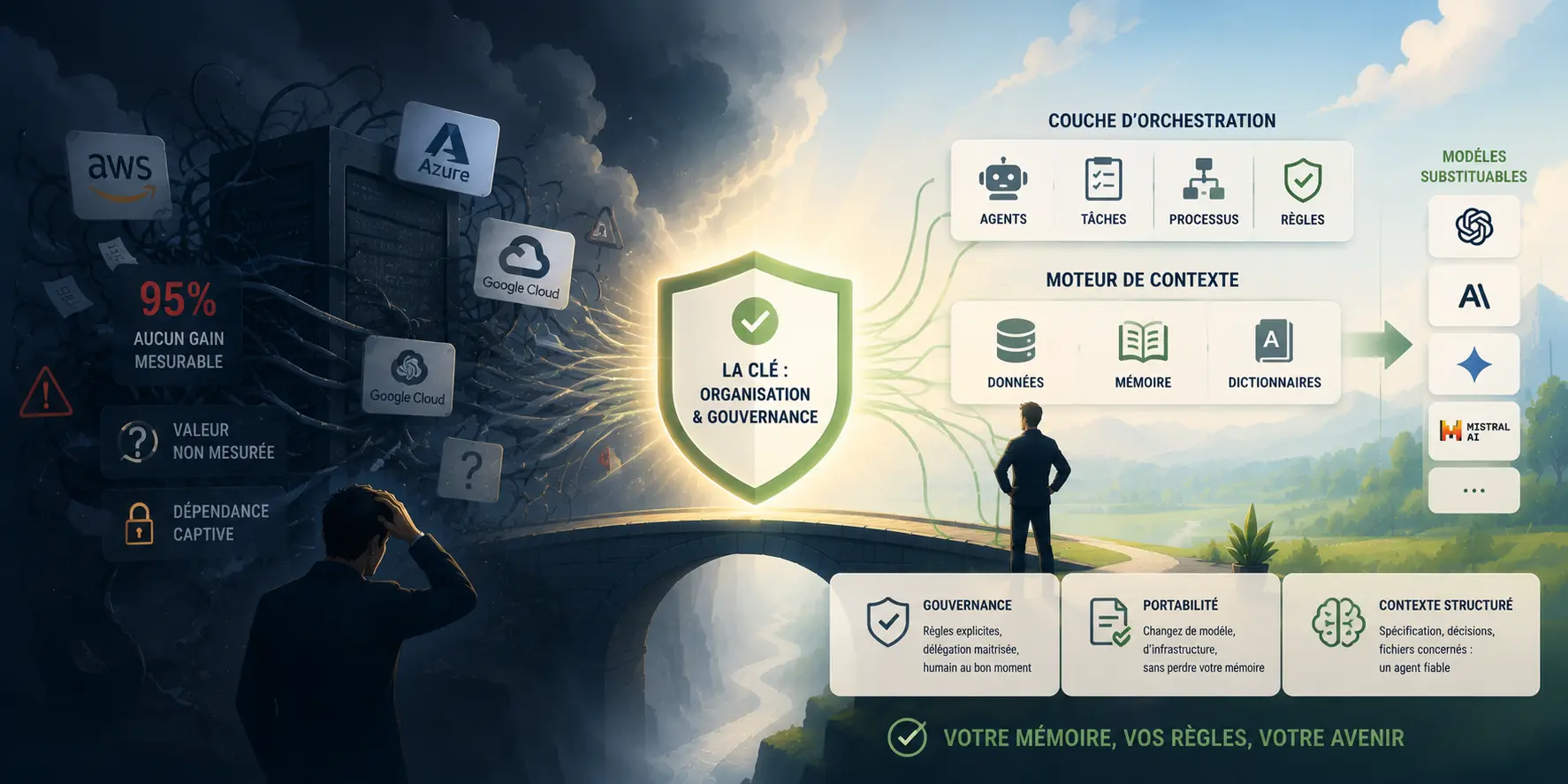
In an interview published by La Tribune on 16 June, Charleyne Biondi, author of an Institut Montaigne paper, sets out a diagnosis that is getting a lot of airtime: AI adoption by French companies rose from 33% to 40% in a year, but "95% of AI projects produce no measurable gain". Plenty of fuel for the sceptics. We read it the other way round: it is one of the most optimistic papers published this year.
Why? Because the headline says it all: "the problem is not technology but the organisation". If the blocker were technological, you would have to wait for the next generation of models and hope it would be enough. But the blocker is organisational - and a company can act on that today, without waiting for anyone.
"Technology is never the magic wand you spread like a mousse on top of what already exists: you have to rethink your operations for the age of AI." - Charleyne Biondi
The 95%, or the value we cannot measure
First thing the paper puts back in perspective: that famous 95%. As Charleyne Biondi points out, "it does not mean it produces no value, but rather a value we cannot manage to quantify". Employees who save time, deepen their expertise, cover broader ground - that is real, but hard to put a number on, especially for knowledge work at an individual scale.
The turnaround she describes is spectacular. Six months ago, many executives demanded a guaranteed 50% ROI before investing. Today, "we see companies of every size telling themselves there is a deep transformation dynamic under way". AI becomes a competitive force you can no longer do without. The question is no longer "should we go for it?" but "on what terms?". That is exactly the right question.
Where sovereignty is really decided
The most important passage in the interview, to our eyes, concerns "captive dependency". The paper warns: as data, processes and decision memory get entangled in mostly American platforms, the balance of power shifts towards the vendors. But - and this is the decisive nuance - that captivity does not happen where you would expect:
"There is not really a dependency on the models themselves: the base layer is generally quite easily substitutable. The layers you are captive to are the strategic cloud infrastructure, and above all that absolutely essential layer between the company's core business and the foundation model." - Charleyne Biondi
In other words: the battle of foundation models is not the point. The point is the orchestration layer - the one that coordinates agents, tasks and processes - and the context engine - the one that manages data, memory and business dictionaries. "If you control that layer, you can change models, migrate from one infrastructure to another, without losing your memory or your business rules."
We could not agree more. That is, word for word, the design principle that guides us at Survol: never hardcode the model, the host, or the source control provider. The AI agent, source control and hosting all sit behind interfaces with one adapter per provider. We start with Claude and GitHub, but the abstraction exists from day one. The promise is simple: the product's memory belongs to you, and it stays readable whichever model you plug in tomorrow.
The "zero lock-in" test: a good orchestration layer must be unpluggable. If switching model or tool makes you lose your product memory and your business rules, that is not orchestration, it is a lock. Portability is not an option: it is the criterion.
Governance is not watching - it is deciding
The paper lands another point squarely: "executive teams often confuse observability with governance. Watching what AI does is not the same as deciding what it is allowed to do." You have to define the guardrails, and above all "who will be responsible for what, for which outcome, and at which point you put the human back in the chain".
That is exactly the line we draw. Steering an AI is not contemplating a stream of logs; it is calibrating delegation: deciding what you entrust to the agent, setting the thresholds for human intervention, organising quality control. Concretely that means explicit rules at three levels - mandatory (never bypassed), strong (the agent may challenge it with arguments, a human settles it), preference - injected at the start of every session and logged on every application. And product decisions discussed before the machine is launched, not observed after the fact.
The real blocker: semantics
One last point, more technical but central: without business dictionaries, without explicit rules, "agents generate plausible but wrong answers", which sends integration and audit costs through the roof. The lesson holds for agentic development too: a coding agent without business context produces plausible but off-target code. The remedy is not a longer prompt, it is a structured context - the feature's spec, the decisions already settled, the files actually concerned. That is what turns an impressive assistant into a reliable colleague.
The takeaway
- "95% with no measurable gain" is not a verdict on AI, it is a measurement and organisation problem - therefore surmountable.
- Sovereignty is not decided on models (substitutable) but on the orchestration layer and the context engine. Control it, and you keep the upper hand.
- Governing means deciding what AI is allowed to do and where the human takes over - not merely watching.
- There is a real opening for interoperable, non-captive European solutions. We fully intend to be one of them.
The Institut Montaigne paper reads like a set of requirements. Reorganisation, explicit governance, portability, semantic structuring: these are not constraints, they are the conditions for AI to finally deliver on its promises. And the good news is that none of it is waiting for the next generation of models.