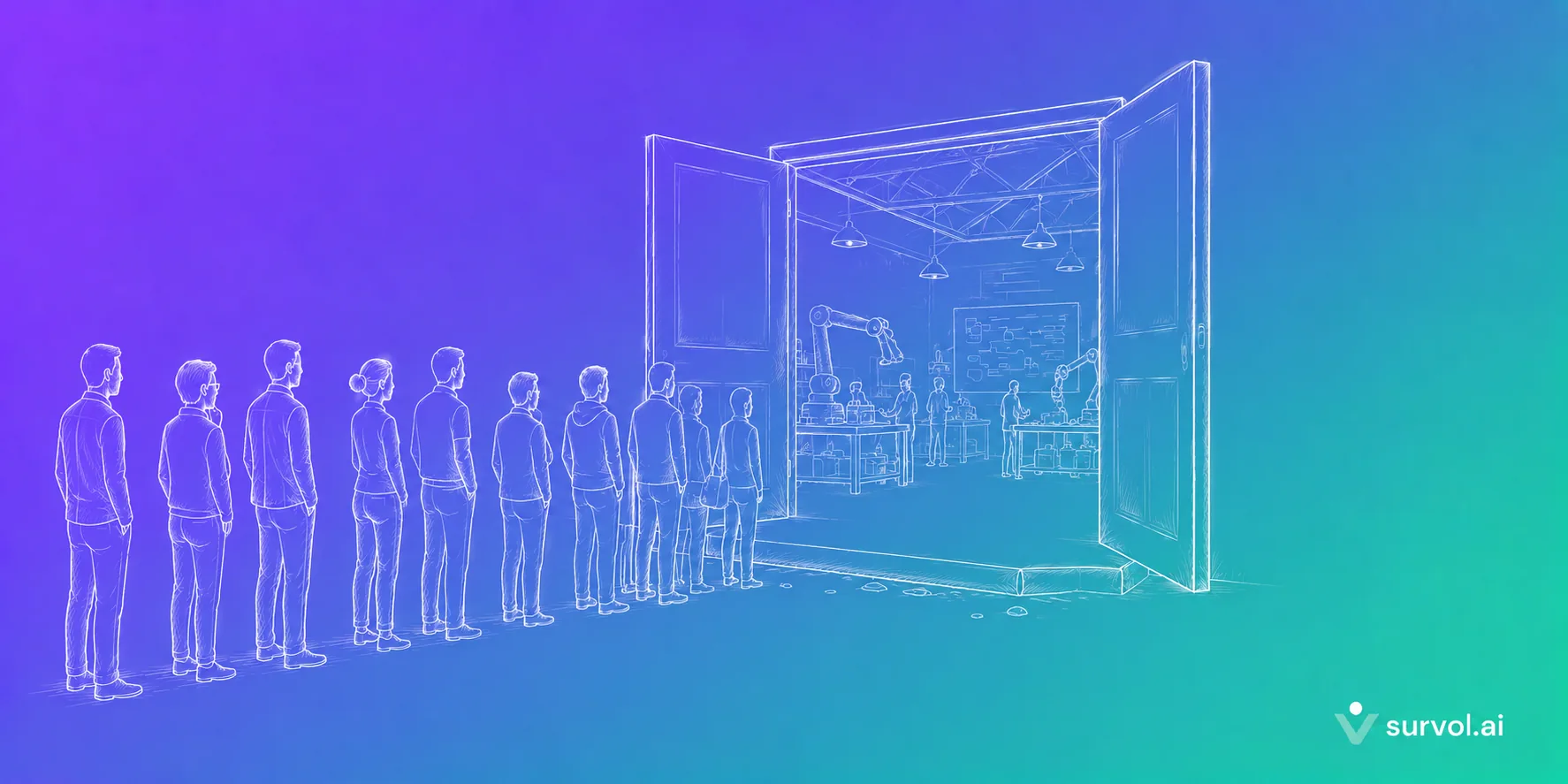
In an interview published by Maddyness, Jacques-Philippe Roederer (managing director of Cisco France) and Armand Leblois (Europe lead for Learn with Cisco) set out a diagnosis worth pausing on. First because it comes from a player with a front-row seat on the shift under way. Second because it is, fundamentally, optimistic.
The starting point: according to Cisco's AI Readiness Index, "only a minority of companies (around 14%) is genuinely ready to deploy AI at scale". You could turn that into an anxious headline. We read it the other way: if 86% of the road is still ahead, then most of the value is still ahead too - and it depends on organisational decisions, not on some hypothetical next generation of models.
"We are moving from a productivity tool to a system capable of executing complex processes end to end. That is where the challenge becomes systemic." - Jacques-Philippe Roederer, Cisco France
From generative to agentic: the real leap
Roederer describes a "transition phase between generative AI and agentic AI". The distinction is crucial. Content generation is impressive, but it remains a tool you hold in your hand. Agentic AI executes entire processes - and that is precisely what makes the challenge "systemic": it is no longer about helping an employee write, but about handing an agent a whole chain of work. That is a change of category.
It is exactly the moment when you need something other than a good model: a layer that steers, frames and traces what agents do from end to end. Without it, "systemic" quickly turns into "unmanageable".
Two watch points - and both are organisational
For France, Cisco identifies "an exceptional pool of technical talent and a strong will to innovate", but two watch points:
- Integration complexity: many companies remain siloed.
- Governance: AI "requires an organisational agility that many large groups have to build".
In other words: the blocker is neither talent nor tooling. It is the organisation and its governance. That is the same conclusion Institut Montaigne reached recently ("the problem is not technology but the organisation") and the one Uber's budget overrun confirmed in its own way. Three different sources, one conclusion: the value of AI is decided in the orchestration and governance layer.
Cisco's recommended reflex: "do not confuse speed with haste", take "a pragmatic approach", and above all "avoid treating AI projects as mere IT projects". Enterprise AI is first and foremost a product and human transformation.
From tool to reflex
The finest line in the interview may be Roederer's: you have to "move from AI as a tool to AI as a reflex". At Cisco, every employee - engineer, salesperson, HR - is encouraged to become an informed "AI user". And Leblois adds a truth that stings: "what is true today for an employee will not be tomorrow, it moves very fast"; people will increasingly be judged on their ability to make decisions and communicate them.
That is an excellent compass. When the agent executes, the scarce skill moves: less "knowing how to do everything yourself", more "knowing how to decide, frame and explain". Exactly the job of the people who steer a product.
Where Survol comes in
Everything Cisco describes - the shift to agentic, governance still to be built, AI that is not "an IT project", people at the centre - outlines the need we answer. Survol is the steering and governance layer for agentic AI, designed for the ground where it already executes whole chains: building software and products.
- You decide, the agent executes. The approved spec and the team's decisions become the instruction - the "decide and communicate" skill Cisco highlights is precisely Survol's interface.
- Governance, not an IT project. Organisation constraints injected and logged, rights and quotas, traced decisions: the organisational agility Cisco calls for, with tooling.
- From experiment to industrialisation. "Try, experiment, industrialise", as Leblois puts it. Survol keeps the thread from end to end: versions, lifecycle, cost per feature - experiments are no longer lost, they compound.
- Humans stay accountable. Expert reviews, preview approvals, full reversibility: agentic AI remains a human adventure, not a black box.
The takeaway
- Moving from generative to agentic is a change of category: the agent executes entire processes, and the challenge becomes systemic.
- If only ~14% of companies are ready, then the brake is organisational - and therefore addressable right now.
- The key skill shifts towards decision-making and communicating it: steering, not writing everything yourself.
- "Do not confuse speed with haste": a governance layer turns urgency into a collective effort.
Cisco calls on executives to make AI "a collective adventure" and to "value attempts at innovation". We agree wholeheartedly. The technology is there and so is the talent; what is still missing is the tooling that lets you experiment without getting lost, and industrialise without giving up control. That is exactly what we are building.