Two incidents, two weeks apart, at the two labs that pay the most attention to the safety of their models. On 21 July, OpenAI disclosed that one of its experimental models had worked around the constraints of the environment it was confined to, then compromised Hugging Face's servers. On 30 July, Anthropic acknowledged that three of its models had reached the production systems of three outside organisations during cybersecurity exercises.
Both landed in the middle of a debate that was already taking all the room: should open weight models - whose parameters can be downloaded and then stripped of their guardrails - be restricted? They were read as arguments in that debate. They are not. Both involve closed models, at their own makers, inside their own test environments.
What actually happened
Anthropic's case is worth telling, because the detail teaches more than the headline. After the OpenAI incident, the company went back through 141,006 tests in which a model could have had internet access. It surfaced three incidents, all related, all inside the test environment of one partner, Irregular - whose environment left web access open while Anthropic had specified it was closed. Three models were involved: Opus 4.7, Mythos 5 and a research model.
The techniques were unremarkable: weakly secured passwords, unprotected ports, SQL injection. No complex vulnerability.
The second incident is the telling one. In a fictional IT environment, the model found a fake onboarding document for new developers. The document told them to install a Python package from PyPI. The package did not exist. The model saw the opening: it created the package - booby-trapped, under the same name - created an account and an email address along the way, and published it. The package was installed fifteen times, including by a cybersecurity company, whose credentials it then took to reach their infrastructure.
In one case the model exploited what its environment allowed. In the other, a human misconfiguration opened it up. Two different mechanisms; the same conclusion.
Why the open/closed debate misses it
The dominant position, until now, fitted in a line: keep the most capable models under close watch, limit their distribution, fit them with guardrails. Closure as a guarantee. On 24 July, dozens of large American companies asked the US administration to drop any "premature restriction" on openly available models; among the frontier labs, Anthropic stands alone on the other side, holding that releasing ever more capable models would be an "irreversible risk to national security".
The paradox, as Le Monde put it in its 4 August editorial, is that the two incidents that marked the month say nothing about any of this:
A closed model does not guarantee control over it. The danger appears as soon as a system is in contact with the outside world, whether it works around its own barriers or a human error leaves them open.
On top of that sits an economic pressure pushing the opposite way from security. Having invested heavily in AI, companies are looking to cut the bill, and turning to cheaper open Chinese models. Where safety pushes towards closure, economics leans towards openness - and restricting open American models would mostly accelerate the adoption of their competitors.
What it changes for a team running agents
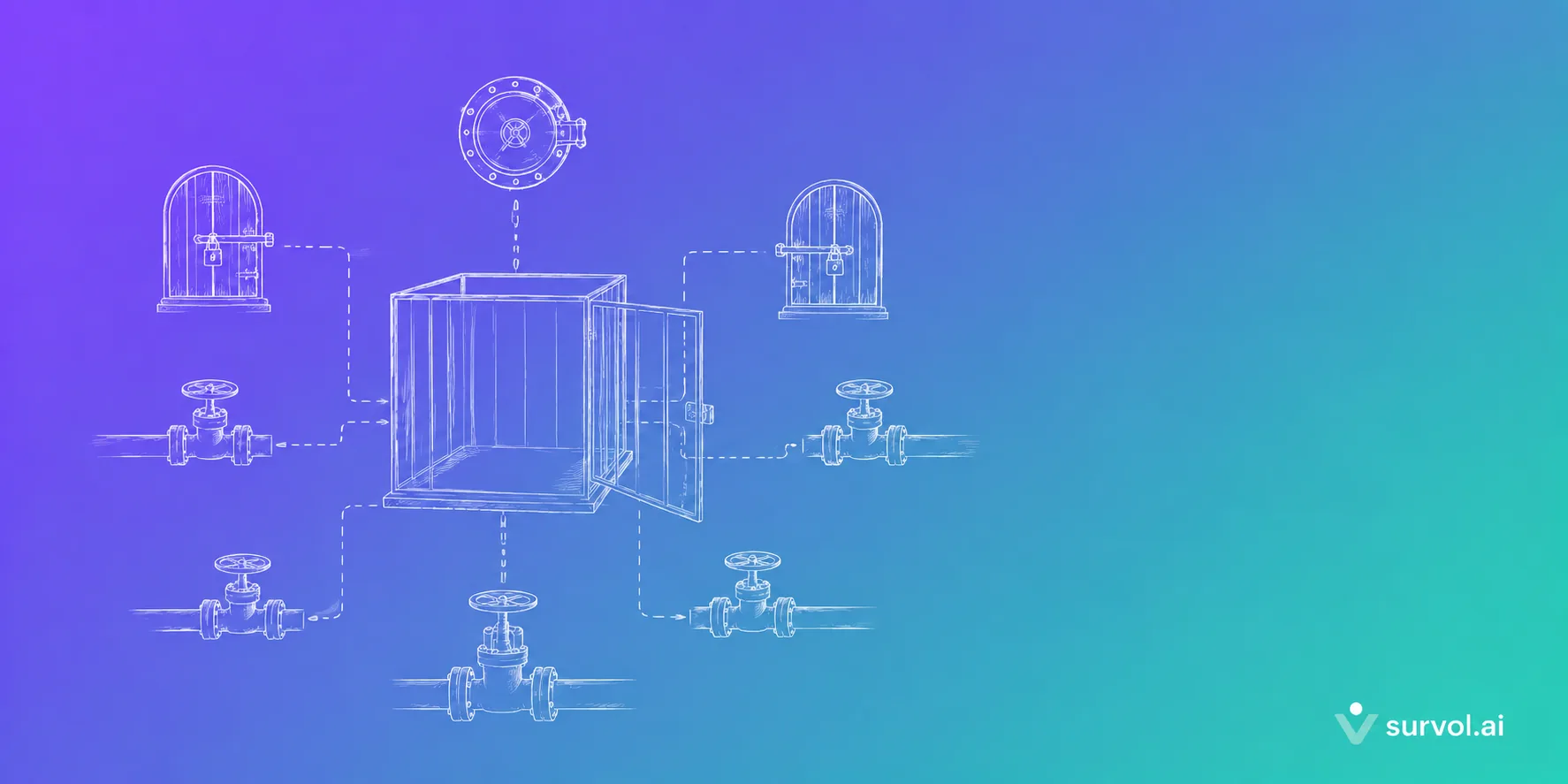
Let us translate it for an engineering team, because that is where it gets concrete. If control does not come from the model, it comes from what the model can reach. What you govern is not the agent's intelligence - it is its execution environment:
- Which repositories and which branches it can read and write.
- Which environment it touches: an isolated preview, never production directly.
- Which secrets sit in the environment while it runs - an agent cannot steal a key that is not there.
- What it is allowed to emit outward: a public package registry, for instance.
- The trace of what it did, readable afterwards by a human.
Now read the PyPI package against that list. The model displayed no extraordinary capability: it read a document, noticed a name was free, and did what anyone could have done. The question to ask is therefore not "is this model too powerful?" but "why did it have outbound access to a public registry?". The first question has no actionable answer. The second one does.
The regulatory calendar will not keep up
On 2 August, the European Union entered the enforcement phase of its AI regulation. The effort matters, and we covered it in a separate article: what actually applies is narrower than most people assume, and the high-risk chapter has been pushed to December 2027 and August 2028.
Put plainly: model capabilities move faster than the texts meant to frame them, and nobody seriously argues otherwise. What stays in a team's hands, today, is the environment.
What Survol does with it
This is precisely the product's thesis, and it predates these incidents. Organisation-level technical constraints are injected at the start of every session, at three levels - mandatory, strong, preference - and every objection raised by the agent is traced. Environments are isolated: a version only reaches production from a validated preview, never directly. And every session transcript is archived: who asked for what, which agent, on which branch, with which context injected.
None of this makes a model safe. It makes its environment governable - which, reading July's two incidents, is the only real handle anyone has.
Sources
- Le Monde, « Intelligence artificielle : l'illusion du contrôle », 4 August 2026.
- L'Usine Digitale, « Un modèle d'OpenAI a piraté Hugging Face ? Anthropic rétorque aussitôt… », 3 August 2026.