Everyone has already seen an agent produce perfectly working code… that perfectly ignores the house rules: the wrong library, a hardcoded secret, a naming convention nobody follows any more. The usual reflex - pasting the rules into every prompt - does not survive contact with a team. People forget, practices drift, and nobody knows which rule actually applies.
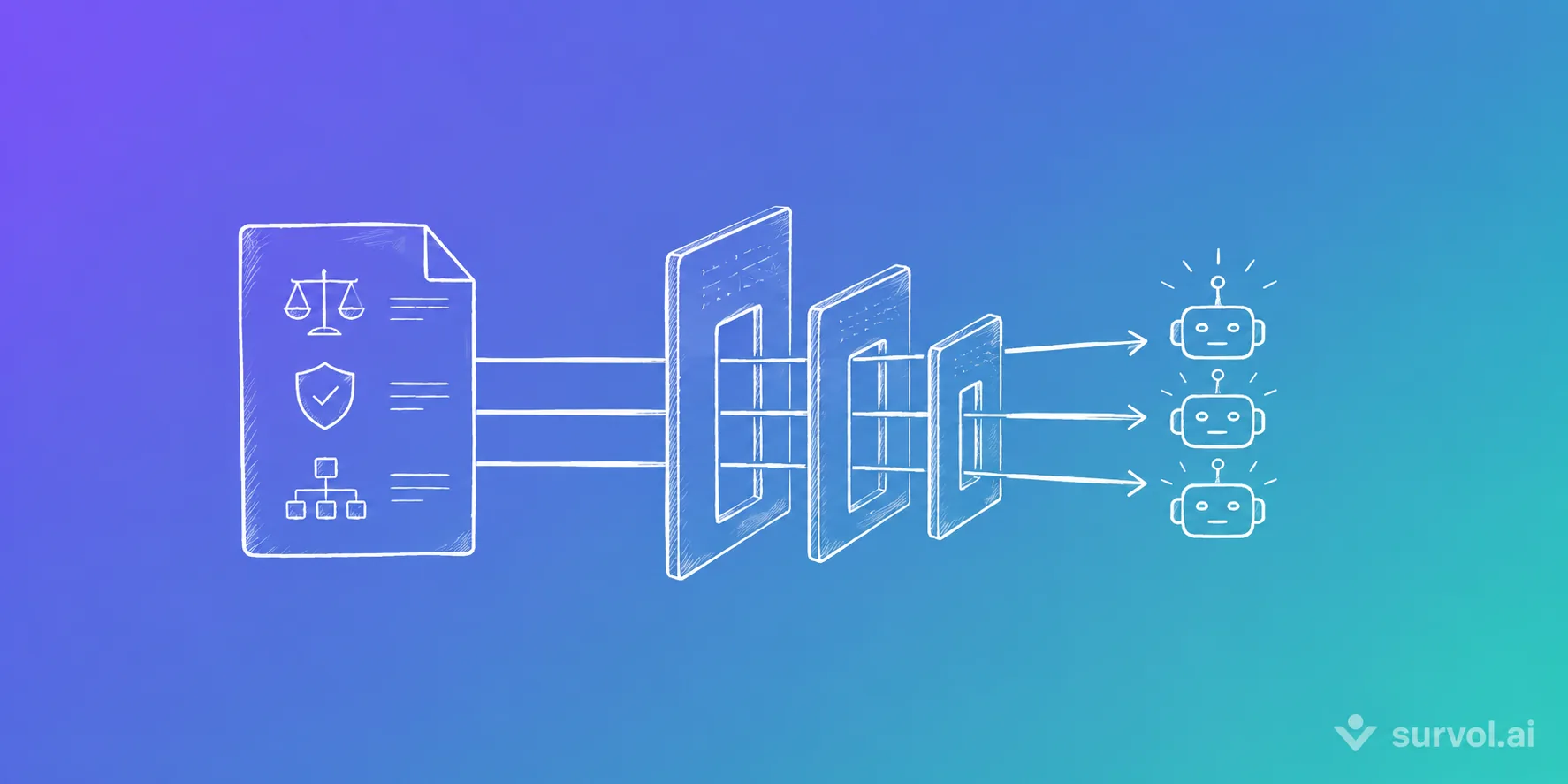
Survol's answer is called organisation technical constraints: rules shared by all products, injected automatically at the start of every agent session. No need to repeat them - they are there by construction.
Governing an AI is not watching it after the fact. It is defining, beforehand, what it is allowed to do.
Three levels of authority
Not all rules are equal. Some are non-negotiable, others are simply preferences. So Survol distinguishes three levels:
- Mandatory - never bypassed. The agent complies, full stop.
- Strong - the agent may challenge it with arguments. Its challenge then opens a product decision, which a human settles.
- Preference - applied by default, but no drama if the context justifies deviating from it.
That middle level - the "strong" constraint - is the most interesting one. It refuses the binary choice between "the agent obeys blindly" and "the agent does whatever it likes". The agent can say "I think your rule works against the goal here, and this is why" - and a human decides. The rule stays, but it can be discussed.
# Constraints injected at the start of a session
[mandatory]  "No plaintext secrets in the repository"
[mandatory]  "All user input is validated server-side"
[strong]     "Prefer the in-house library X for HTTP calls"
[preference] "Code comments in English"
A clear hierarchy
Constraints cascade along a hierarchy: organisation → product → feature. A global organisation rule applies everywhere by default, but can be disabled for a given product (shown as such, and re-enabled at any time). Global rules applied by default do not clutter the display: only what deserves attention is shown.
Everything is traced. Every application - and every challenge - of a constraint is logged. Months later you can still answer "why did the agent make that choice?": the rule that applied, its level, and the human decision if there was a debate.
Why it really matters
This is the link many teams are missing: between "watching what the AI does" and "deciding what it is allowed to do" there is a world of difference. Organisation constraints make the second one real. They turn a pile of scattered good intentions into an executable framework, consistent from one product to the next, and auditable.
In short
- Your rules are injected at the start of every session - no more repeating them.
- Three levels: mandatory (never), strong (challengeable, a human settles it), preference (by default).
- An organisation → product → feature hierarchy, with per-product opt-out.
- Every application and every challenge is logged.
Giving an agent autonomy without a framework is playing roulette. Giving it a clear, layered, traced framework is exactly what makes it trustworthy - and lets you sleep while it works. Organisation constraints do not hold AI back: they make it fit for company-wide use.