On 7 July, Ethan Mollick - Wharton professor and one of the most listened-to voices on enterprise AI - posted a message that passed 22,000 views within hours:
"Even before the agentic revolution, prompting tricks had stopped adding much, as our research showed. The best approach to AI today: clearly specify your goals, your output, what good and bad results look like, and how to test… (yes, it's just management)." - Ethan Mollick, 7 July 2026
Backing him up: four technical reports from Wharton's Generative AI Labs, the Prompting Science series, unpacked in an excellent summary by explainx.ai. Their purpose: to scientifically test, on demanding benchmarks (GPQA, MMLU-Pro), the incantations that prompt-engineering culture has been selling for two years. And the top reply in the thread says it all: "the unlock was writing a real spec. It always was - prompt tricks just hid it."
Let us be honest: at Survol, we read all of this with a broad smile.
What Wharton actually tested - and buried
Four reports, one per popular belief:
- "Be polite to the model" / "always enforce the format" (report 1): a contingent effect - the same phrasing helps on one question and degrades the next, with no reliable way to predict which. There is no universal prompt formula.
- "Think step by step" (report 2): marginal gains on recent reasoning models - which already reason internally - for answers 20 to 80% longer. In other words: you pay more to duplicate work already done.
- Tips and threats (report 3, with the delicious title "I'll pay you or I'll kill you - but will you care?"): no significant improvement. Promising the model $20 or threatening to unplug it is theatre, not engineering.
- Expert personas (report 4): "you are a world-renowned physicist" does not improve factual accuracy. A persona can adjust the tone, not the facts.
Honesty requires reading the limits: these studies measure accuracy on hard multiple-choice questions, not creative or strategic work. Personas remain useful for voice (an executive summary vs developer documentation), and chain-of-thought is not forbidden - it has simply become marginal on recent models. Mollick is not saying "prompts don't matter"; he is saying that tricks do not matter. Specs do.
What replaces the tricks: four manager's questions
Mollick's checklist fits in four points, and it is a management checklist:
- The goal - what outcome this session must produce. Not "help me with the code": "the customer must be able to pay for their booking in three instalments, without breaking the mobile journey".
- The output - format, scope, constraints, what must not be touched.
- Good and bad - acceptance criteria and anti-patterns: what gets it approved, what gets it rejected.
- The tests - how you verify before shipping.
And Mollick insists on a point we find crucial: the format matters less than the content. PRD, requirements document, procedure - use whatever your organisation already reads. The model does not reward the aesthetics of a prompt; it rewards readable requirements. Exactly like a good engineer or a good contractor.
Why the agentic era makes this vital
Mollick is clear: the tricks had lost their value before the agentic revolution. But agents change the scale of the problem. In question-and-answer mode, a vague instruction produces a bad answer - the human sees it, corrects it, and you start again. In agentic development, a vague instruction produces hours of multi-file, multi-tool execution… in the wrong direction. An under-specified agent does not fail politely: it confidently delivers the wrong thing.
That is the practical conclusion of the explainx.ai summary: value has moved up a level. It is no longer in the magic prompt formula, it is in the quality of the specification, the assembly of context and the verification loops. The industry's vocabulary has followed - less and less talk of prompt engineering, more and more of context and loop engineering.
"It's just management" - that is exactly our bet
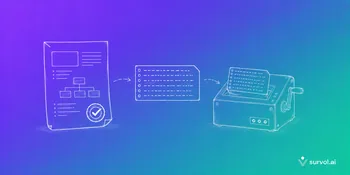
When we started building Survol, we set out a principle that felt almost provocative: the user never types a prompt - the approved spec IS the prompt. The Wharton reports and Mollick's thread describe, with evidence, why that is the right interface. We turned Mollick's checklist literally into product:
- The goal? That is the feature sheet: what the user must be able to do, written in plain language, discussed as a team, versioned.
- Good and bad? Those are the settled product decisions - dated, voted on, attached to the spec - and the organisation's technical constraints (mandatory, strong, preference), injected automatically at the start of every session and logged.
- The output? A version, on its branch, with its merge request - a clean scope, not a stream of conversation.
- The tests? Acceptance test books, run by a human on an identified environment, and the preview to approve before any promotion.
Even our stance on optimisation comes out reinforced: if incantations are useless, every token spent on "think really hard" boilerplate is a token wasted. That is why Survol trims context down to what is strictly needed - the approved spec, the settled decisions, the files concerned - and picks the model for the task. Prompting science meets budget management.
And there is a corollary we find genuinely exciting: if the key skill is specifying, then the best "prompt engineers" of the agentic era are product people. The ones who know how to describe a need, arbitrate, and set acceptance criteria. Agentic development does not require learning a grimoire - it requires doing the product job well, with tooling that turns that work into executable instructions.
The takeaway
- Prompt tricks (politeness, tips, threats, personas, systematic chain-of-thought) do not survive the test bench: contingent effects, certain costs.
- What works: the goal, the expected output, good/bad criteria, tests. A spec, in short - in whatever format your team already reads.
- Agents raise the stakes: under-specified, an agent delivers the wrong thing confidently. Verification must be tooled, not hoped for.
- The scarce skill moves towards product: describing, arbitrating, setting criteria. That is very good news for product teams.
"Yes, it's just management", Mollick concludes. We would happily add: product management. That is the craft Survol equips - the spec as instruction, decisions as guardrails, tests as the exit gate. Two years of prompt folklore have just dissolved into four research papers; what remains is what has always made good products. We are not going to complain.
Sources: "Ethan Mollick: Prompting Tricks Are Over - Wharton Prompting Science Backs Real Specs", explainx.ai, 7 July 2026 · Wharton Generative AI Labs, Prompting Science series, reports 1 to 4 · Ethan Mollick's X thread (@emollick), 7 July 2026.