In February, a team of researchers led by Nicholas Bloom published an NBER survey of nearly 6,000 executives across the United States, the United Kingdom, Germany and Australia. The result fits in one line: roughly nine in ten see no effect of AI on their firm's productivity or employment over the past three years. Fortune promptly ran a story about economists reviving a forty-year-old paradox.
The paradox is Robert Solow's, and the comparison holds. It is more instructive than it looks, provided you do not stop at the 1987 line and go on to read the rest: how, where, and on what condition that paradox was resolved.
The 1987 line
On 12 July 1987, in a piece for the New York Times Book Review, the economist Robert Solow wrote: "You can see the computer age everywhere but in the productivity statistics".
The context matters. Since the early 1970s, US productivity growth had been slowing even as companies poured money into computing. Computers were landing on every desk and the curve would not move. This was not doubt about the technology: it was a puzzle about measurement and timing.
What the NBER survey says
The 2026 numbers have the same shape. More than two thirds of the executives surveyed use AI regularly, but for 1.5 hours a week on average. 28% do not use it at all, the most common answer is up to an hour a week (41%), and only 7% spend more than five hours on it. Over three years, roughly nine in ten see no effect on their firm's employment or productivity.
The same executives nonetheless expect an effect over the next three years: +1.4% productivity, +0.8% output and −0.7% employment on average. That is the exact structure of Solow's paradox in miniature: the technology is everywhere in the expectations and nowhere in the results.
Two caveats before going further. These are executives reporting on their own firms, not productivity measurements: no effect means no perceived effect. And three years is very short on the scale of the transformations discussed below.
How the 1987 paradox ended
Solow's paradox did not stay a paradox. According to the McKinsey Global Institute, US labour productivity grew 2.5% a year between 1995 and 2000, nearly twice the 1.4% pace of 1972 to 1995. Computing did show up in the statistics, less than a decade after Solow wrote his line.
But how it happened matters more than the fact that it did. The same institute found that six sectors out of 59 (wholesale, retail, securities, semiconductors, computer manufacturing, telecommunications) accounted for virtually all net productivity growth over the period, through innovations that were managerial as much as technological. The gain did not come from computers being everywhere. It came from a few places that had changed how they worked around them.
The electric motor in the steam factory
In 1990 the economist Paul David published in the American Economic Review what is still the most illuminating answer to Solow: "The Dynamo and the Computer". He compared computing to the electrification of factories around the turn of the twentieth century, whose effects also took decades to reach productivity.
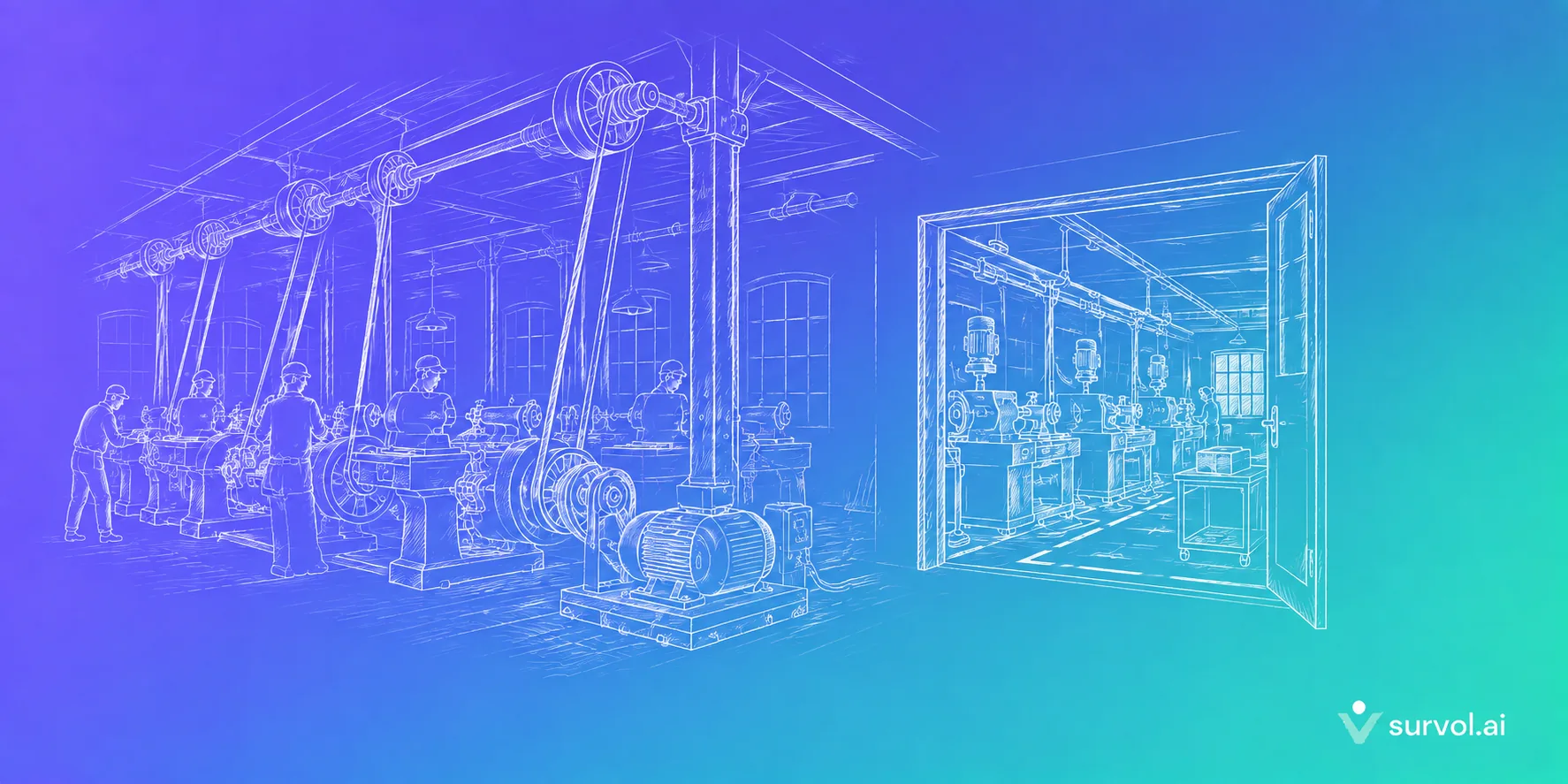
His explanation is organisational. The first electrified factories replaced the central steam engine with a central electric motor and kept the same shop-floor layout and the same ways of working. The gain only came with factories redesigned around the new power source. A technology of that scale does not deliver its effects by being installed: it delivers them when workflows, skills and management practices are reorganised around it.
Read the NBER survey through that lens. An hour and a half a week is a side use: AI added to a working day that is otherwise unchanged. It is the electric motor dropped in where the steam engine stood, driving the same line shafts. That is a reading, not a finding of the study, but it predicts what the study observes rather well.
Why the numbers can dip first
Erik Brynjolfsson, Daniel Rock and Chad Syverson gave this intuition a precise form in 2021: the productivity J-curve. A general-purpose technology, and they count AI among them, requires large complementary investments: new processes, new products, new business models, new skills. Those investments are mostly intangible, and poorly captured by national accounts.
The consequence: in the early years, measured productivity growth is underestimated, because the reorganisation effort is counted as a cost while the asset it builds is not counted at all. Later, when those assets pay off, it is overestimated. Hence the J: a dip, then a rise.
That changes how to read the nine in ten. No effect after three years is consistent with two opposite stories: one where nothing will happen, and one where reorganisation has started and not yet paid off. A self-reported survey cannot tell them apart. And a firm that genuinely reorganises may, for a while, look less productive than one that changes nothing.
The useful question is not about the gains
If the history of computing repeats itself, and nothing guarantees it will, AI's gains will arrive late, unevenly, and first wherever someone has redesigned the work. Not necessarily where usage hours are highest.
For a company, then, the useful question is not whether the gains are there after three years. It is what it has reorganised around AI, as opposed to what it has merely added to it. We made the point about an Institut Montaigne note: the brake is not the technology, it is the organisation. At team scale, it is also what Luc Bonnin's forty-day experiment explained: teams report saving 30% of their time while delivery plans stay put, because the gain is absorbed elsewhere (supervision, hidden debt, nobody whose job it is).
What we do with this
Survol starts from that bet, and it is better to say so plainly: the gain will not come from agents added to an unchanged development process, but from a process redesigned around them. The approved specification becomes the source of truth, every session is tied to a feature and its version, every decision is traced. That is our version of the factory redesigned around the motor.
We do not yet know whether that bet will show up in our users' numbers, and we will not promise it before we have measured it. Solow's story at least tells us where to look.
The takeaway
Solow was right in 1987, and so were those who answered that it would take time. But the paradox did not fade with time alone: it was resolved in a handful of sectors that had changed how they worked. The executives who see nothing do not prove that AI is useless. They describe, fairly accurately, what a technology looks like once it is installed but not yet adopted.
Sources
- Ivan Yotzov, Jose Maria Barrero, Nicholas Bloom et al., "Firm Data on AI", NBER Working Paper 34836, February 2026. Survey of nearly 6,000 executives (CEOs, CFOs and senior executives) in the United States, the United Kingdom, Germany and Australia. The survey figures quoted here come from it.
- Fortune, article of 17 February 2026 linking the NBER survey to the Solow paradox.
- Robert Solow, "We'd better watch out", New York Times Book Review, 12 July 1987, p. 36. Citation established by The Standup Economist.
- McKinsey Global Institute, "US Productivity Growth 1995-2000", 2001.
- Paul A. David, "The Dynamo and the Computer: An Historical Perspective on the Modern Productivity Paradox", American Economic Review, vol. 80, no. 2, May 1990, pp. 355-361.
- Erik Brynjolfsson, Daniel Rock, Chad Syverson, "The Productivity J-Curve: How Intangibles Complement General Purpose Technologies", American Economic Journal: Macroeconomics, vol. 13, no. 1, January 2021, pp. 333-372.