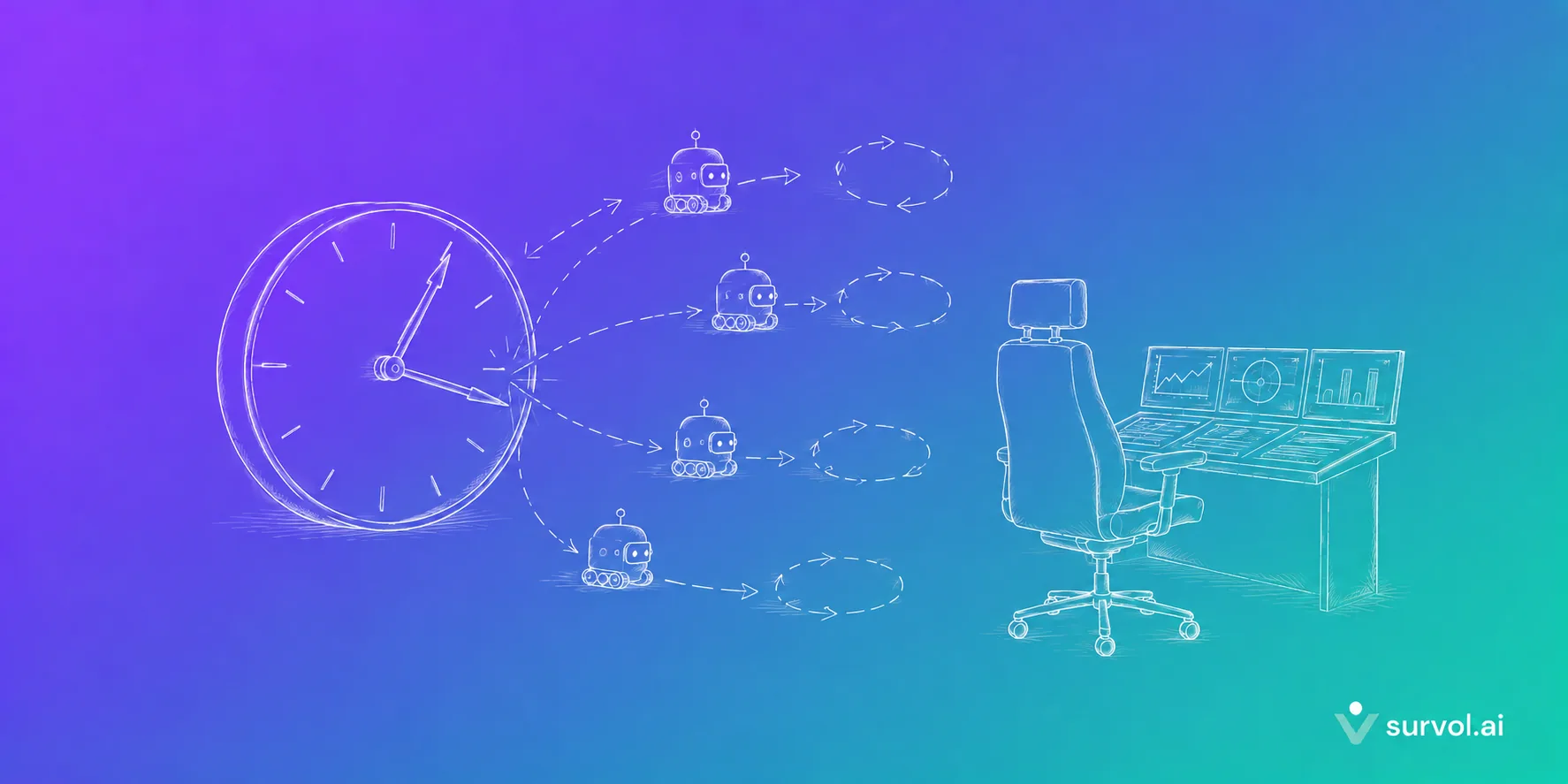
On 18 June, OpenAI rolled out a redesign of scheduling in ChatGPT, unpacked by Blog du Modérateur and documented in OpenAI's help centre. The "Tasks" feature had existed since January 2025 but stayed discreet and limited; it now becomes Scheduled Tasks: a dedicated page in the sidebar that centralises every active task, shows the next occurrence, and lets you pause, edit or delete without reopening a conversation.
Beyond the convenience, two changes really matter. First, monitoring tasks: ChatGPT can now watch the web or a connected app and alert you only when a relevant change occurs - the conditional logic that was sorely missing. Second, the disappearance of Pulse, the morning briefing, whose functions are absorbed into this new system. In short: scheduling becomes a first-class building block.
"Ask ChatGPT to check whether anything is new and tell you when it's worth it." That, in one sentence, is the move from reactive AI to proactive AI.
What it really changes
For a long time AI has been summed up as a loop: I ask, it answers. Scheduled tasks break that loop: the agent works while you are away, once or repeatedly, and comes back to you with a result or an alert. That is exactly the promise of agentic AI - and seeing it land in the most widely used consumer product in the world is an excellent adoption signal.
The update is refreshingly lucid about its own guardrails, and that is where it gets instructive for companies:
- Quotas per plan: 3 active tasks on Go, 5 on Plus, 10 on Business/Edu, 15 on Pro/Enterprise. The resource is counted.
- A capped cadence: no more than one run per hour, and inactive tasks pause themselves.
- Managed permissions: in a Business or Enterprise workspace, the admin decides which apps can be connected, and a task may require approval before it acts.
- Acknowledged limits: no webhooks for now - so it suits scheduled check-ins, not yet event-triggered automation.
Translation: as soon as you industrialise agents that run on their own, you need quotas, visibility, permissions and governance. The same ingredients Uber discovered it was missing when its AI bill exploded. Autonomous scheduling makes those needs sharper still: an agent running without you can also drift, cost, or fail without you.
Worth noting: OpenAI clearly separates ChatGPT's scheduled tasks (reminders, monitoring, briefings) from Codex automations (code workflows). The underlying signal is the same on both sides: agentic work is becoming scheduled, recurring and asynchronous. That is precisely Survol's territory.
Autonomous scheduling is in our DNA
At Survol, the idea of an agent working while you sleep is not a novelty to catch up with: it is a founding principle. Our auto-resume 🌙 parks an agent session when the plan limit is reached, then picks it up again as soon as credit returns - when you wake up, the merge request is open. That is resilient scheduling applied to software development, not a simple timer.
But the real question OpenAI's announcement raises is the step after: when you have not one scheduled task but dozens, spread across a team and several products. At that point it is no longer about creating a task, it is about administering and supervising them. And that is exactly what Survol is designed to do:
- One overview. Every agentic session and task in one place, with its next occurrence, its status and its history - the "Scheduled page", but at organisation scale and connected to your products.
- Cost attached to value. Every run consumes tokens - the customer's money. Survol tracks spending per session, per version and per feature, not just per person. A recurring task that costs without delivering stands out immediately.
- Governance injected. Organisation constraints (mandatory, strong, preference) apply at the start of every run, and every application is logged. An autonomous agent stays inside the framework you set.
- Team quotas and rights. A company token pool, per-member quotas, a per-feature rights matrix: who is allowed to launch what, and how far.
- Supervision, not surveillance. Detected changes (including those made outside Survol) are surfaced and attached, never in an informer's tone - the human keeps control and decides.
What about staying provider-agnostic?
OpenAI adds scheduling to ChatGPT; others will add it to their agents. That is precisely why Survol hardcodes neither "Claude", nor "OpenAI", nor "GitHub": we speak of an AI agent, of tokens, of tasks and of providers behind adapters. The layer that matters tomorrow is not the model - models are substitutable - it is the layer that orchestrates, administers and traces what your agents do when you are not there. Survol intends to be that layer, whichever agent is on the other end.
The takeaway
- ChatGPT's scheduled tasks confirm that proactive, recurring AI is becoming the norm - and that is exciting.
- The more agents run on their own, the more you need quotas, visibility, permissions and governance. OpenAI acknowledges as much in its own guardrails.
- Creating a task is easy; administering and supervising dozens of agentic tasks across a team is the real challenge - and that is where Survol comes in.
Autonomous scheduling is not a gimmick: it is the moment AI stops being a tool you hold and becomes a colleague working in the background. What remains is to keep, on that tireless colleague, the same thing you keep on the others: a clear view of what it does, what it costs, and what it is allowed to do.