You should read Simon Rimbert's "The Shape of Thought After AI". It is one of the rare pieces that describes not what AI does, but what it changes in us when it works well. His thesis fits in one image: "I don't feel faster, I feel like my limbs got longer." AI does not replace thinking; it moves its boundary. "Hands are no longer the edge of the mind."
You could stop at the euphoria. But Rimbert does something more interesting: he explains on what condition that augmented thinking holds up. And that condition is, word for word, what we are building at Survol - not for thought in general, but for the most concrete object there is: a software product built with agents.
Associative thinking finally has somewhere to go
Rimbert describes a mind that, on receiving any piece of information, sees "a dozen connections": which project it affects, which past decision it contradicts, which risk will surface in six weeks, six months, six years. Before AI, following those branches was "prohibitive" - each one created reading, writing, coordination. "The mind could travel further than the hands."
That diagnosis is exactly the one we make about product development. A request comes in, and a good PM immediately sees the ramifications: which feature is affected, which earlier decision is called into question, which cross-product contract is at risk. Before, those branches died for lack of time. Survol exists to give them a place: a decision that opens, gets discussed, gets settled and linked to the feature; a dependency you declare; a product map that unfolds the implications instead of letting them evaporate. "What should the system remember so the same mistake does not happen again?" asks Rimbert. That is, literally, the question a traced product decision answers.
Work stops being linear: orchestration, not multitasking
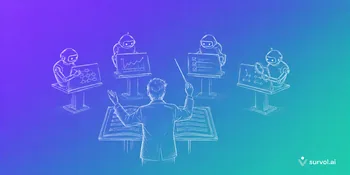
The heart of the essay is here. With a good model and persistent context, Rimbert says, work becomes "spatial, multi-threaded, architectural". One conversation shapes a presentation, another handles a strategic discussion, two more write code or analyse data. And he insists: "this is not multitasking" - multitasking splits attention badly between competing activities. "It looks more like orchestration. Each thread has a purpose, a state, a confidence level. Some need tight supervision. Others move on their own for a while."
Replace "threads of thought" with "agent sessions" and you have the exact definition of Survol. We orchestrate sessions - each with its task, its state, its capability tier, its consumption, its required level of verification. Some run alone and resume during the night; others wait for a decision to be settled. This is not opaque multitasking: it is traced orchestration.
Rimbert notes that "the unit of work changes": you no longer move small operations (open, search, copy, edit) but blocks - an architecture, a prototype, a testing strategy, a narrative for stakeholders. That is precisely our unit: the version of a feature, not the line of code. You steer intents that become deliverables, not gestures.
The vault: absorbing detail to keep altitude
Then comes the keystone, and the passage that made us smile. "This way of working collapses quickly without persistent context. Five conversations with AI are not a system: without shared memory, they are five intelligent strangers producing disconnected fragments." Rimbert's answer is what he calls his vault: "structured, usable context. It is useful not because it remembers everything, but because it gives everything a shape."
And he says what the vault lets him do: "stay above the system without losing access to its details". We have had an expression for that since day one: your product, seen from above. A vault for a software product is not a pile of notes - Rimbert says so: "a pile is not a system, you need paths, indexes, rules about what is reliable, what must stay private, what to load and when". That is word for word Survol's specification: the spec, the decisions and their why, the technical constraints (mandatory / strong / preference) injected at the right moment, the session history. The vault that absorbs the detail so the team keeps its altitude.
"I copy myself into the system": from tacit judgement to infrastructure
Rimbert's favourite sentence - and ours - is this one: "I am gradually turning tacit judgement into explicit infrastructure." When the model produces something off, he explains why it is off, and that correction "can become more than one-off feedback: a rule in the vault, a behaviour, a decision principle, a reusable test". He is not copying his personality into the system; he is copying "his corrections, his standards, his scars".
That is exactly what a product governance platform must capture. At Survol, a correction does not stay an unpleasant memory: it becomes a dated product decision, an organisation constraint that will apply to every future session, a test book case that records what must not break again. Where Rimbert turns his personal judgement into infrastructure for himself, Survol turns a team's judgement into shared infrastructure - for humans and agents alike. "I copy myself into the system" becomes "we write our collective judgement into the product".
"Model feel": calibrated trust, not binary trust
One last point we want to salute, because it is so often caricatured: trust. Rimbert refuses the false debate of "trust it or check everything". He describes a model feel, a sense of the model: "the right level of control moves continuously" depending on the task, the stakes, the quality of the context. "A manager does not supervise every person at the same distance."
Serious governance does exactly that: it modulates control. Survol equips it with configurable gates (no production release until the preview test book has passed), expert reviews on demand, previews to approve - more control where the stakes are high, less where the move is safe. Rimbert's calibrated trust, applied not to one person's intuition but to a team's pipeline.
The takeaway
- AI does not think in our place: it moves the boundary of thought. "Hands are no longer the edge of the mind" (Rimbert).
- That augmented thinking is not multitasking but orchestration - threads that each have a purpose, a state, a confidence level. That is our model of agent sessions.
- It collapses without a vault: structured context that gives shape, keeps altitude, and turns tacit judgement into explicit infrastructure.
- For a software product built by a team, that vault has a name: Survol - spec, decisions, constraints, history, governance. Your product, seen from above.
Rimbert concludes that today's models "are not the destination, but the first visible crack in a wall we had mistaken for the edge of the room". We share that vertigo. And we would add something modest: for the crack to serve building a product - and not only thinking bigger for an afternoon - you need a place that keeps all of it alive, shared and governed. Rimbert calls that place his vault. For your software, we call it Survol.
Source: Simon Rimbert, "The Shape of Thought After AI", Medium, 2026. Quoted passages are from the original English text.