In a report published by HelloWorkplace, Delphine Soulas picks out four predictions from VivaTech 2026 about how AI is reshuffling work. What strikes you reading them: none of them is really about technology. They are all about organisation, roles and human skills. In other words, they describe the exact ground Survol was designed for. Let us go through them.
1. "Many more managers" - to steer agents as well
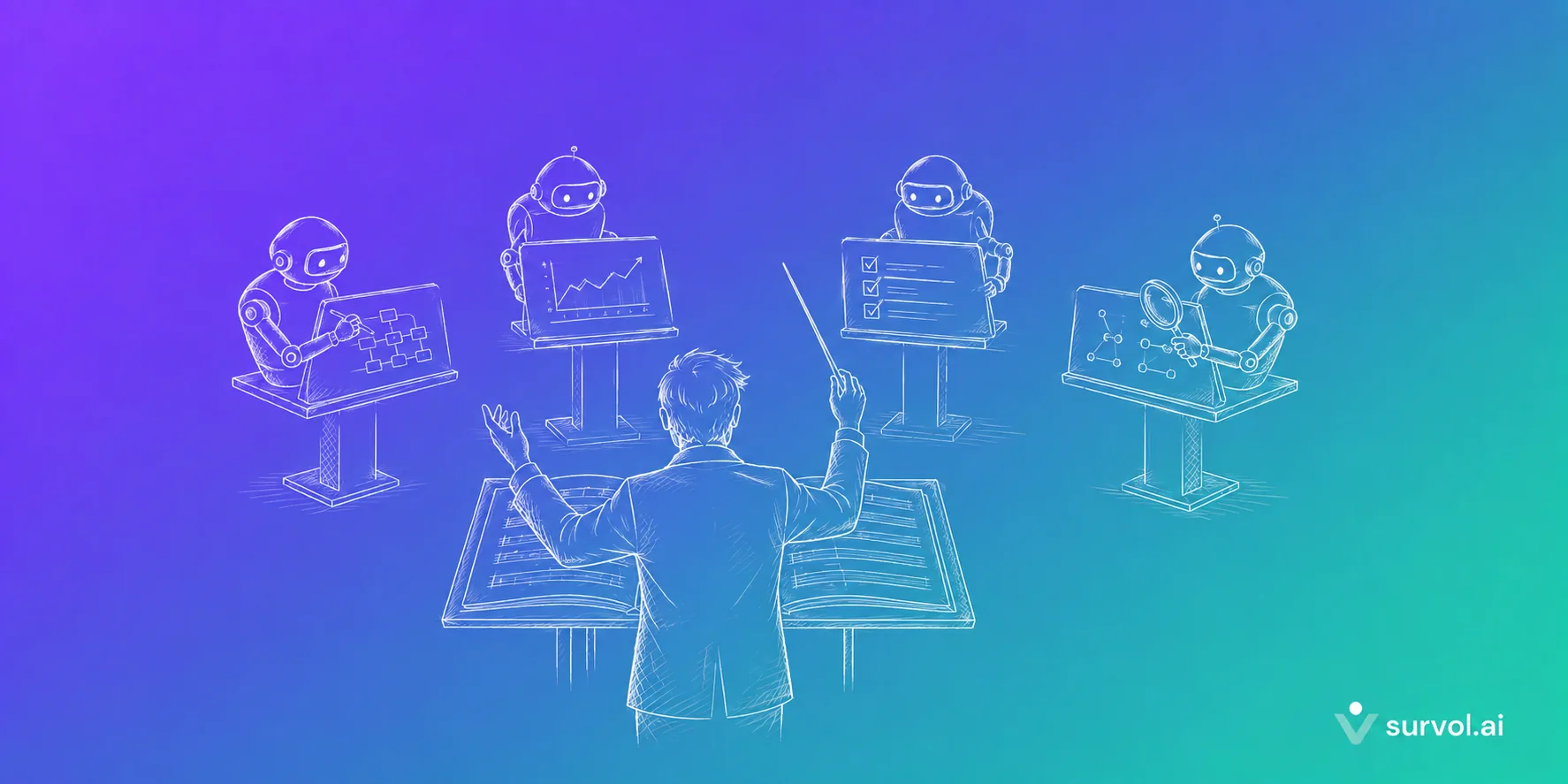
The first prediction is probably the most counter-intuitive. Far from emptying org charts, agentic AI would add a layer to them: "Tomorrow there will be many more managers, or equivalent, to drive action", predicts Pierre Aubouin (Caisse des dépôts). Because on top of their human teams, managers will have to steer "entire teams of AI agents" - directing them, correcting them. Éric Salobir (Fondation Human Technology) adds: "managers will no longer be the gatekeepers of knowledge: their role shifts towards that of a coach."
"Tomorrow there will be many more managers, or equivalent, to drive action. It will raise the noble layer in every job." - Pierre Aubouin, Caisse des dépôts
Steering a team of agents requires somewhere to do it. That is precisely what Survol is: an agent cockpit. You launch sessions there, follow what each agent is building in real time, redirect it with a product decision, approve or ask for changes. The manager who "drives action" without writing code is exactly Survol's user - the one who describes a feature, settles the open questions, and lets the agent execute. And the "gatekeeper of knowledge → coach" shift Salobir describes is what we equip: the knowledge is no longer in an expert's head, it is in the spec, the traced decisions and the organisation's constraints, readable by everyone.
2. Critical thinking as a core skill - provided you can exercise it
The second prediction is a warning. Julien Tanguy (Lefebvre Dalloz) points to "two big risks with AI: errors and overconfidence", and fears that professionals will "become lazy and stop questioning AI". Nicolas Crozatier (Inria) warns that agentic AI makes it worse: what agents produce will have to be "constantly verified, which takes substantial resources".
That is at the heart of our conviction. An AI that executes without being open to question is not progress, it is a black box. Survol is built to make critical thinking practicable, not heroic:
- Nothing reaches production without human review. Every version goes through a preview to approve and a merge request - verification is a step in the journey, not an act of individual goodwill.
- Verifying should not exhaust you. The risk of "intellectual overheating" comes from re-checking everything by hand. Survol structures verification: acceptance test books, expert reports readable by a non-developer, prioritised findings turned into tasks in one click. Attention is focused where it counts.
- Disagreeing is a designed gesture. Our organisation constraints have three levels - mandatory, strong, preference - and a "strong" constraint can be challenged by the agent, with arguments, which opens a decision for a human to settle. Disagreement is logged, not smothered. That is critical thinking written into the product.
Gabrielle Halpern's warning - if everyone delegates the same tasks and verifies the same way, we risk "a standardisation of ways of thinking". The answer is not to delegate less, but to keep a record of the why: at Survol, decisions are discussed as a team, voted on, and remain readable. Diversity of viewpoints is archived, not smoothed away.
3. "Do it differently, do something else" - capitalise instead of accelerating
Éric Salobir distinguishes three uses of AI: "do it faster", "do it differently to create more value", and "do something else". Many companies are still on the first - simple time savings. Moving to the next two means not losing what you produce along the way.
And that is where agentic development most often goes off the rails: you move fast, but you lose the mental map of the product - what is done, in which version, on which branch? Survol exists so that speed turns into capital, not debt: every feature versioned, every decision dated, every token attached to the value delivered. "Doing it differently" becomes possible because you keep the thread of what you have done - experiments are no longer lost, they compound.
4. Reinventing how knowledge is handed down
The last prediction touches on passing knowledge between generations. Young professionals now access information "once reserved for experts", but risk missing "the depth that only experience builds". Hence the need, says Pierre Aubouin, to "reinvent the transmission of experience".
This may be where Survol's role is quietest and deepest. In a product steered with Survol, experience is no longer tacit: it is written down and located. Product decisions explain why a given choice was made; the organisation's technical constraints encode the house rules and inject them at the start of every session; the session history keeps a record of the reasoning. A new joiner - or a new agent - does not start from zero: they inherit a readable team memory. Transmission stops depending on an expert's availability; it becomes a property of the product.
The takeaway
- Agentic AI does not flatten organisations, it creates a role: steering agents. Survol is the cockpit for that role.
- Critical thinking stays central - provided it is tooled: reviews, previews, challengeable and traced constraints make it practicable rather than exhausting.
- The real gain is not speed but capitalisation: versions, decisions and costs keep the thread of what AI builds.
- Transmission is reinvented when experience is written down and located - spec, decisions and constraints become the team's memory.
VivaTech 2026 confirmed a shift we have observed from day one: the value of AI is decided not in the model, but in how you frame it, question it, and capitalise on what it produces. Tomorrow's managers will steer agents the way they steer teams - with objectives, guardrails and memory. That is exactly the cockpit we are building.