The most common fear about agentic development is not "AI will write bad code". It is "AI will write code behind my back, and I will no longer know why". A black box that produces code you cannot discuss, and cannot have reviewed by someone you trust. That fear is legitimate - and it is precisely what Survol is built to avoid.
Our conviction: humans keep control. Not as a reassuring slogan, but as a concrete mechanism, at two points in the workflow: before the agent writes code, and after.
Delegating execution is not delegating the decision.
Before: the product decision is discussed between humans
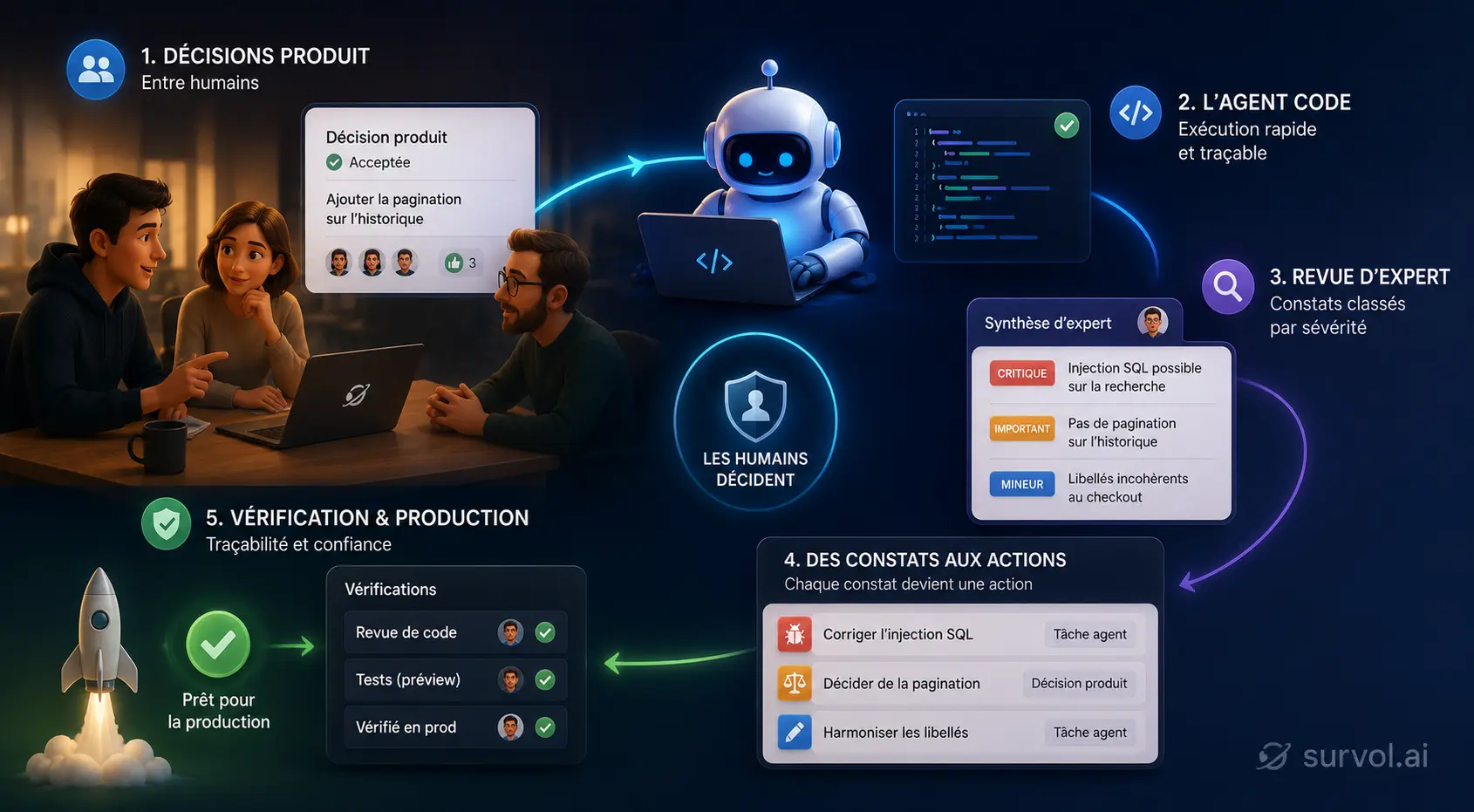
At Survol we never start an agent session on an unsettled question. Product decisions are discussed - as a team, and if useful with the agent as a contributor, never as a referee. A decision has a clear lifecycle: open → accepted / rejected → implemented, with its dates, a thumbs up/down vote, the list of voters, and an optional link to a feature. Once it is settled, the decision feeds the agent's context. Not before.
After: the expert review becomes tasks
Code is not sacred just because an agent wrote it. Survol includes human expert reviews: you order a report from a domain expert, who returns findings graded by severity - critical, important, minor - with a proposed fix for each one.
And that is where the loop closes cleanly: every finding is actionable in one click. From a finding you create either a task for the agent, or a product decision if something has to be settled first. Comments stay shared with the expert. The report is not a PDF sleeping in a drawer: it is an entry point into the work.
# An expert report, turned into actions
finding [critical]  "Possible SQL injection in search"      → agent task
finding [important] "No pagination on the history view"     → product decision
finding [minor]     "Inconsistent labels at checkout"       → agent task
Beyond reviews: Survol also lets you order a support engagement (quoted, depending on criticality) or a specific analysis (quoted, with a stated scope). Human expertise is a first-class building block, not a last-resort option.
Verification, not just code
Trust is not declared, it is traced. Every version carries its verification state: who reviewed the code (a human or an agent - useful on manual versions), which test books were run, by whom and on which environment, who checked in production. The direction we are heading: turning those verifications into configurable gates before promotion - for example, forbidding a production release until the preview test book has passed.
The takeaway
- Product decisions are made between humans, before the agent is launched.
- An expert review converts, finding by finding, into tasks or decisions.
- Every version keeps a record of who verified what - trust is documented, not assumed.
A good agentic tool does not try to replace human judgement; it puts it in the right place and makes it effective. AI writes code fast - all the better. But it is still a human who decides what deserves to be written, and a human who says "yes, this can go to production". Survol simply equips those two moments. That is all, and that is the essential part.